
I've been a fan of music and writing for as long as I can remember. This is not unique.
But, I feel I have been an appreciative fan of good music and great writing for almost as long. Again, this is probably not unique.
I've never felt compelled to meet many writers, specifically authors of books. But, I have felt compelled to meet some of my musical heroes. (Though not all.) Meeting James Brown, John Hiatt, the guys from Del Amitri and The Jayhawks and Steve Earle (hat tip to The Coyote Club) were each great moments. Stories that I am uniquely able to tell when the occasion is appropriate.
Not meeting Johnny Cash and Ray Charles when I had the chance count among my biggest regrets. Along with the one author that I would have liked to have met — Hunter Thompson. This doesn't account for Mark Twain who was not alive during my lifetime, but I thought I should add this note.
There is a fabled crossroads. It's been written and sung about numerous times. The trope is about a man down on his luck and maybe down to his last dollar, or final chance, whatever. The man comes to a crossroads, makes a hard choice, that seems hard for him at the time, but in retrospect it was the easy/logical choice. Then, after the hard choice is committed to, his life "magically" gets better. Not only better, but the stuff of Legend.
I'm here to talk about a different crossroad.
This post is about Tom Waits. It's a fan letter of sorts. The crossroad is Waits writing, lyricism, and imagery and the kaleidoscopic musical tapestry. It is like no other. Poetry in a clown car doin 120MPH.
The wrong way on a one way.
Uphill.
At night.
With the lights off.
"They say I have no hits and that I'm hard to work with. And they say it like its a bad thing!" — Tom Waits, Rock and Roll Hall of Fame induction ceremony.
How does someone discover music like Tom Waits'? It certainly never got any radio air play. I remember reading about Tom Waits in Rolling Stone magazine a long, long time ago. But, the gap between reading that rag then being able to put a CD or cassette in the machine and play any of his music was so unimaginable to me that I never crossed the chasm. Back then, if the library didn't have it, and the radio wasn't playing it, you had to hope it was on one of the mix tapes that you bought from an ad in the back of Hit Parade. OR, truck your ass down to the record store and buy it.
I'll put on a curmudgeon cap and say "Back in my day, a friend played it for you." It is likely that no unique artist like Tom Waits will ever be 'discovered' again. The algorithm won't optimize for it. There certainly will never be another artist like Tom Waits. The world is a sadder place in some regards for that.
Perhaps I only think that way because the friend that played "Blue Valentine" for me has passed away and now he'll never introduce me to new music ever again. Perhaps, like many people as they age, I feel a melancholy for Today's Youth. They'll never have the advantage that I had. It's a pessimistic slant fo sho!
Enough maudlin.
The BEST thing about Tom Waits is not his lyrics, his music or his voice, although all three of those qualities are sterling and magnificent. It's this:
"She rescued me. I'd be playing in a steak house right now if it wasn't for her. I wouldn't even be playing in a steak house. I'd be cooking in a steak house." — Tom Waits, on his wife and collaborator, Kathleen Brennan.
I admit when I was younger, that statement and others like it, would have struck me as polite. A surface platitude. Now as I gain (some) wisdom, I realize this type of genuine humility and appreciation is so common in genius that I have to wonder if it is some sort of prerequisite.
An artists' appreciation for his partner is a common thread that runs betwixt all of the Greats. It is the shrew and the tyrant that think that their success is due to their efforts alone. After all, "success has many fathers, failure is an orphan." But, Waits' admiration for his partner doesn't affect me directly, other than an external signal of his genius. So I'll talk about that voice briefly, then get on to the poetry and music and its impact.
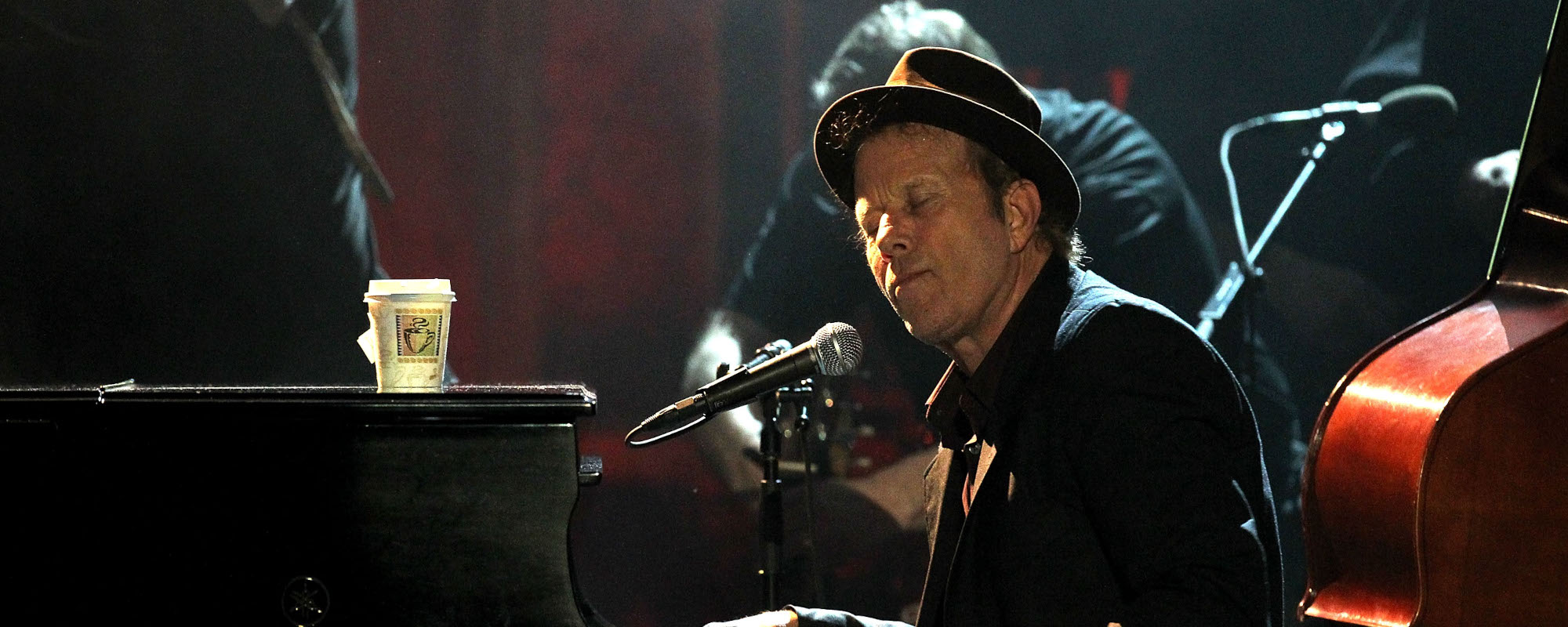
You really have to listen to (not just hear) it for yourself. tomwaits.com
Tom Waits' voice is most often described as gravelly, guttural, and raspy — a distinctive sound that has become his signature. Critics and fans alike frequently use vivid metaphors to capture its unique texture. His voice is capable of surprising nuance: while it can sound abrasive and forceful, it can also convey vulnerability and tenderness, particularly in his love songs, where the damaged quality suggests experience and emotional depth.
Now, that horse is dead. Let's circle back to the Poet.
He's the poet laureate of The Lost and, sometimes, the found; the drunks and the dreamers, the kind of guy who could write a ballad about a bird falling in love with a whale and make you believe every word of it. His music isn't just heard — it seeps. Like a hot tub laced with tea tree oil, it just gets into you. It's inhaled, like the scent of rain on hot pavement or the acrid tang of a burned-out neon sign.
Waits is arguably the last of the true troubadours, a man who's spent his life mining the dark veins of society's underbelly and coming up with gold almost every time. He doesn't just sing about the world; he conjures up Worlds from Shadows, with that voice and a soul that's seen too much pain and misery to possibly bear, and a heart that still believes in love and miracles. To listen to Tom Waits is to step into a world where the piano is always out of tune, but it just still seems just right.
To me, he's a legend, sure, but I'm not a blind groveling sycophant. I enjoy his spinning tales that make me laugh, cry, and wonder what the hell I'm doing with my life. I love his art because he's the guy that walks that line, lives to tell the tale, so you don't have to, then doesn't begrudge you that you didn't take the ride too. In other words, a True Artist. In a world full of noise, he's one of the few who sounds like the Truth.
Take "Goin' Out West." This isn't some gentle ballad or a wistful ode to lost love. No, this is a fistfight in a bar, a shot of rotgut whiskey, and a smirk in the face of the devil. The song's a swaggering, stomping beast — part blues, part rock, all attitude. It's a middle finger to convention, a celebration of the outlaw spirit, and a reminder that sometimes, you just have to get the hell out of Dodge.
He doesn't give a damn if you like it or not.
If that particular ditty is not to your tastes, then there's "Come On Up To The House." This one's the antidote to all that wildness, a gospel-tinged invitation to the lost, the lonely, and the broken. The world's gone to shit — the moon's broken, the sky's cracked — but Waits is there, arms open, ready to welcome you in. It's a song about acceptance, about community, about finding a place where you belong even when everything else is falling apart.
One of the greatest gifts I've ever received is when my wife is practicing piano and she starts playing this tune, I get Tom Waits' voice in my head accompanied by live piano throughout our house. Any day that happens, that is the best day.
Authenticity in music isn't about technical perfection — it's about honesty, intimacy, and the courage to be flawed. Ultimately, the atmosphere of these songs is a reminder that the best art isn't polished or safe — it's raw, honest, and human. It just is. And that's what makes it unforgettable.
So, I'll end here. But maybe you're asking where you should begin. Good.
There are many places you could start with Tom Waits' catalog. I started with Blue Valentine. You could start with Closing Time, his first album — this way you could track the growth of the artist through time. But I suggest Blood Money if this is your first exposure to Waits' music.
Buckle up. You have been warned…
Tom Waits' Blood Money: A Descent into the Human Meat Wheel
It seemed prescient, and way ahead of his time, when I first heard it. Tom Waits drops Blood Money (unleashed in 2002) on your doorstep like a severed horse's head. This isn't just an album — it's a telegram from the underworld, stamped urgent, delivered in a splatter of gin and existential dread. This is the Soundtrack of our current Daily Lives. (as I write this in 2025)
The Carnival of Carnage
Waits and his co-conspirator Kathleen Brennan have hijacked Georg Büchner's 19th-century fever dream, Woyzeck, and run it through the meat grinder of modern malaise. The opening track, "Misery Is the River of the World," is less a song than a mission statement: "If there's one thing you can say about mankind, there's nothing kind about man." The band lurches and staggers behind him, a skeletal army of horns, marimbas, and bass clarinets, as if the instruments themselves are rising from the grave for one last danse macabre.
A Voice from the Abyss
Waits' voice here is a geological event — an earthquake in a coal mine, a landslide of sorrow and sarcasm. He's Charon, ferrying us across the Styx, and every lyric is a coin on our eyes. The album careens from the brutal to the tender, but even the ballads are laced with arsenic.
Tin Pan Alley Meets the Weimar Republic
Musically, Blood Money is a junkyard symphony, where Tin Pan Alley tunes are drunk-rolled in a Berlin alley by the ghosts of Brecht and Weill. The rhythms lurch, the melodies stagger, and the lyrics bite. There's humor here, but it's black as motor oil; there's romance, but it's the cheap, throw-away kind you find in a bar at closing time.
A Political, Carnal Dirge
At its core, this is a political album — a grim deposition on the human condition, where the villains run the show and God's away on business. Sound familiar? Sound like our Current Events? Indeed. Waits paints (in 2002 may I remind you) a world where the bloodsuckers rule, and the rest of us are left to row down the river of misery, singing along because what else is there to do? Or, ya know: a typical Tuesday these days…
"I like a beautiful song that tells you terrible things. We all like bad news out of a pretty mouth. I like songs to sound as though they've been aging in a barrel and distressed." — Tom Waits
Blood Money is not for the faint of heart or the clean of conscience. It's for the Damned, the desperate, the ones who know that the world is a carnival of carnage and the only way out is through. So start here, if you dare.
All of that to say: Thank you, Mr. Waits.
It was weeks, possibly even months between my first listen of Blue Valentine until the portion of my Lizard brain that defies logic and attempts to communicate with me "whats good." The opening lines of "Christmas Card from a Hooker in Minneapolis" started finding me at the weirdest times. I would wake up hearing "Hey Charlie, I think I'm happy / For the first time since my accident." Oh man, so good.